
Executive coaching services provide leaders with structured space to think clearly, test assumptions and turn important decisions into practical action. For leaders and organisations across Africa, the work can be shaped around a role transition, organisational change, relationship challenge or strategic priority rather than a standard set of instructions.
Taking on a new role, leading a restructuring or adapting to a change in organisational direction can challenge familiar ways of working. You may want practical guidance and space to think through decisions in your own context. This article explains what executive coaching involves, how it can support leaders in Zambia and across Africa, and how it differs from therapy, mentoring and consulting. It also covers common coaching goals, costs and how to assess whether coaching suits your situation.
Key Takeaways
- Use a leadership transition or organisational change to clarify the decisions, relationships and priorities that need focused attention.
- Identify whether a challenge is personal, interpersonal or organisational so the support addresses the real need.
- Use the leadership alignment chain to connect vision and strategy with people, systems, resources, activities and outcomes.
- Distinguish coaching from therapy, mentoring and consulting by the purpose of the work and the role each person takes.
- Consider executive coaching when structured reflection can help turn change into clear leadership action.
What is Executive Coaching?
Executive coaching uses structured questions, reflection and practical follow-through to help leaders clarify decisions, develop their leadership capability and navigate transitions. Its value comes from connecting individual leadership practice to the organisation’s priorities and the experience of the people affected by each decision.
Benefits for Leaders and Organisations
A leader can use coaching to test assumptions, strengthen communication and identify practical next steps for a specific challenge. For example, a senior leader preparing to change reporting lines might use a session to clarify the message, anticipate concerns and decide how to involve key people. For an organisation, coaching can help leaders connect their decisions with shared goals and everyday execution. The right approach depends on the leader’s context, the scope of the work and the outcomes being pursued.
Virtual and In-Person Coaching
For leaders in Lusaka and across Africa, virtual coaching can support regular conversations across locations, while in-person sessions allow direct discussion in a shared setting. Choose the format that best supports confidentiality, reliable participation and the work involved. A blended approach can combine both. Options include individual executive coaching and coaching that aligns leaders around shared organisational priorities.
To choose between an independent coach and a firm, compare the leader’s needs with the coach’s experience, method and ability to support the required scope. An agreement should define goals, roles, confidentiality, session arrangements and how progress will be reviewed. Measure progress by setting a starting point, then reviewing agreed leadership behaviours and organisational outcomes. Coaching depends on the leader’s engagement and cannot by itself resolve structural barriers or replace specialist support.
For external context, BCG’s executive coaching perspective and Heidrick & Struggles’ coaching overview discuss coaching in leadership development. Any research findings or figures reported on those pages belong to the named reporting company, retain their original context, and are not AGS results or guarantees.
Support through career and organisational transitions
Career moves and organisational change shift what leaders need to decide, communicate and deliver. Executive coaching can turn those changes into focused action, whether the transition involves a new role, business transformation or more agile ways of working in Zambia or elsewhere in Africa.
Coaching for Organisational Transformation
During transformation, a leader needs to connect strategic intent with everyday decisions. Coaching can help identify where actions, communication or team routines are slowing progress, then establish practical adjustments. For example, during an agile transformation, a leader might examine how quickly teams receive decisions, whether authority sits at the right level and how effectively teams adapt their work. The focus remains on leadership behaviour, organisational conditions and the transformation’s purpose.
Career transitions also change what a role demands. A newly appointed executive may need to build trust with an existing team while learning how decisions move through the organisation. Coaching can help map key relationships, clarify expectations and choose an initial action. This grounds development in the realities of the new role rather than general leadership advice.
CEO Performance and Business Transformation
A CEO leading business transformation must balance immediate performance with decisions that shape future direction. Coaching can create space to examine competing priorities, stakeholder expectations and the CEO’s influence on execution. A useful focus could be a current decision, such as communicating a strategic shift while maintaining operational focus. The work should connect reflection to observable leadership action, not treat transformation as an abstract exercise.
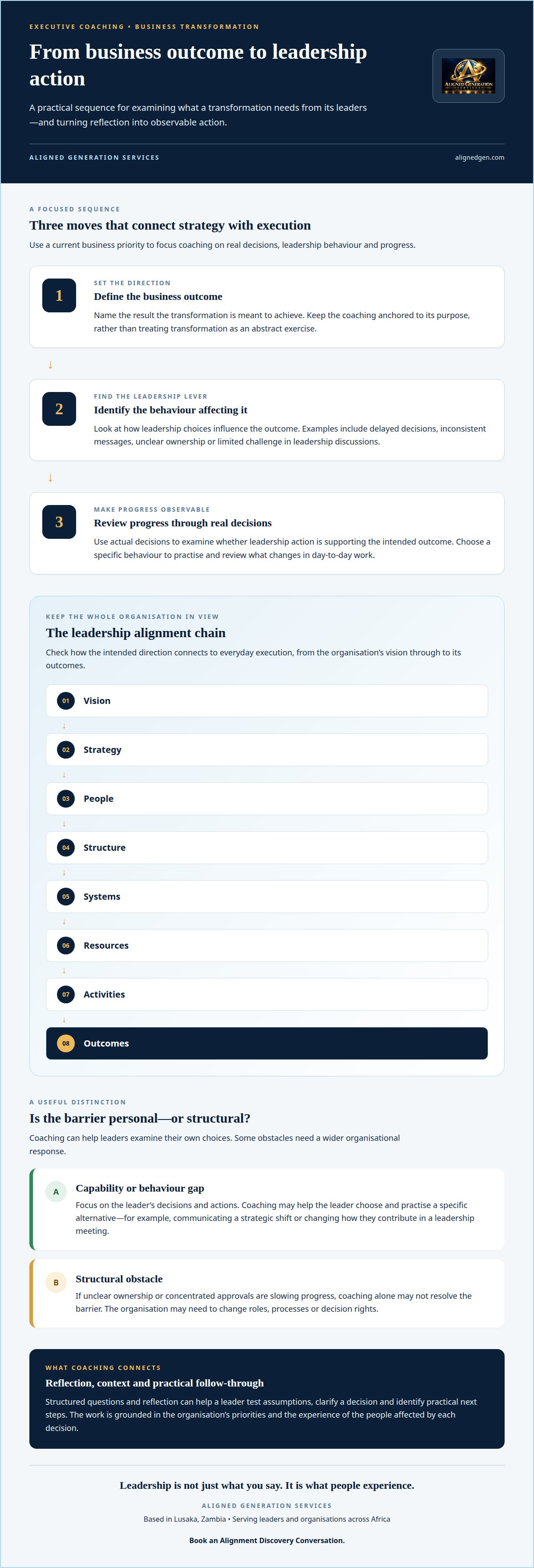
A practical sequence for a CEO is to define the business outcome, identify the leadership behaviour affecting it, then review progress through real decisions. This can distinguish a capability gap from a structural obstacle, such as unclear ownership. The difference matters: coaching can support an individual’s choices, while organisational barriers may require changes to roles, processes or decision rights.
C-Suite Behavioural Transformation
C-suite behaviour sets the tone for senior teams. Coaching can help executives notice patterns such as delayed decisions, inconsistent messages or limited challenge in leadership discussions. The next step is to choose a specific behaviour and practise an alternative in a relevant meeting. This makes change visible in daily interactions and gives colleagues a clearer basis for responding.
When several executives are changing how they lead, align individual goals with a shared direction. For example, leaders can agree how they will communicate priorities, resolve cross-functional tension and sustain customer focus. If you’re defining that work, executive coaching for leaders can help connect reflection to a deliberate action plan.
Personal, interpersonal and organisational coaching needs
Coaching needs can arise at three connected levels: an individual leader’s practice, relationships between colleagues and organisational conditions. Start by naming the issue and where it appears. If a manager struggles to delegate, for example, explore their decision-making, then consider whether unclear team roles contribute. This gives coaching a defined focus instead of treating every performance concern as an individual weakness.
At the personal level, a leader might practise giving concise direction before a high-stakes meeting. A confidential coaching conversation can help examine assumptions, test alternatives and prepare specific language. Interpersonal coaching focuses on how people work together. If two department heads repeatedly disagree over priorities, they can identify the decision causing friction, clarify each person’s role and practise a more direct conversation.
Organisational coaching connects leadership behaviour to strategy and goals. Translate a stated priority, such as improving customer responsiveness, into decisions teams can act on. Then identify who owns each decision, what information they need and where handovers cause delays. This clarifies collaboration without assuming every barrier can be solved through individual development. Some constraints may lie in systems, structures or processes.
For team effectiveness, examine how members share information, handle disagreement and coordinate work during organisational change. A practical review can begin with one shared goal, then assess whether each member understands their contribution, receives consistent direction and can raise obstacles early. Coaching can help leaders address the behaviours and working conditions that shape the team’s experience.
Choose a coaching focus by matching the observed problem to its level. If a leader avoids difficult feedback, work on their personal practice. If teams receive conflicting direction, align the relevant leaders. If a process blocks progress, address that organisational condition alongside coaching. This keeps development connected to real work, measurable goals and the people expected to deliver them.
Coaching compared with therapy, mentoring and consulting
These approaches can all support professional growth, but they meet different needs. Choose by identifying whether you need reflection, wellbeing support, experience-based guidance or a defined solution.
Coaching Compared with Therapy
Executive coaching focuses on the present and future, helping leaders work toward personal and professional goals. A session might examine how a leader prepares for a difficult decision, then identify an action to try. Therapy or counselling is distinct and may address emotional or mental health needs. The difference lies in the purpose of the work, not whether a conversation includes personal thoughts.
Mentoring differs because a mentor typically draws on personal experience to offer perspective or share lessons from a similar career path. A newly appointed director, for example, might ask a mentor how they handled board presentations. A coach instead helps the director examine their own approach and develop a response suited to their context. A development program can include both, provided each role is clear.
Coaching Compared with Consulting
Consulting focuses on analysing a business issue and recommending or supporting a solution. If a company needs to redesign a process, a consultant may assess the current system and propose changes. Coaching helps leaders think through their choices, strengthen their leadership practice and take responsibility for action. It can support a transformation effort, but it does not replace technical analysis or a specific business recommendation.
Use the distinction to match support to the need: choose coaching to help leaders develop their own judgement, mentoring for relevant experience, consulting for specialist recommendations, and therapy for therapeutic support. Some challenges involve more than one need, so define the desired outcome and each person’s role before starting. If leadership reflection is the priority, explore executive coaching as a structured way to turn thought into deliberate action.
Aligned Generation Services: Executive Coaching
Aligned Generation Services (AGS), based in Lusaka, Zambia, provides executive coaching services for leaders and organisations across Africa. Anthony Mwami is The Leadership Alignment Coach and founder of Aligned Generation Services. His coaching work provides structured support for role changes, complex decisions, leadership relationships and shifting organisational priorities.
AGS uses a leadership alignment chain: Vision → Strategy → People → Structure → Systems → Resources → Activities → Outcomes. Each link should reinforce the next. For example, a clear vision may fail to produce the intended outcome when the strategy is not understood by people, decision-making structures are unclear, systems do not support the work or resources do not match the priorities.
Turn the Next Transition into a Deliberate Step
Coaching helps a leader examine the chain and identify where alignment is breaking down. If activities are busy but outcomes remain unclear, the leader might revisit the strategy. If people understand the strategy but cannot act, the issue may sit in structure, systems or resources. The leader and coach can then define corrective measures, such as clarifying ownership, changing a decision process, improving communication or redirecting resources, and review what people experience in practice.
Leadership is not just what you say. It is what people experience. AGS’s executive coaching services connect reflection with observable leadership action, helping leaders consider how their choices affect people, organisational alignment and outcomes. The work may focus on an individual leader or on how several leaders coordinate around a shared direction.
Contact Aligned Generation Services to discuss a focused starting point for your leadership priorities. To begin, describe the change underway, where alignment appears to be breaking down and what better leadership would look like in practice.
Executive Coaching Costs
The cost of executive coaching depends on the scope of the work, the frequency of sessions, the duration of the engagement and whether the format is for an individual leader or a team. AGS can discuss the intended outcomes, practical arrangements and level of support before confirming the appropriate scope.
Frequently Asked Questions
What does the coaching process look like?
The process starts by agreeing on a leadership objective, then using focused conversations to turn it into practical experiments. A newly promoted executive, for example, might bring a difficult delegation decision to a session, consider options and choose an approach to test with their team. Subsequent conversations can review what happened, what people experienced and what corrective action may be needed.
What credentials should I look for in an executive coach?
Look for relevant coach training, leadership experience and a clear explanation of the coaching approach. Ask how the coach handles confidentiality, conflicts of interest and feedback involving an employer or board. A credential can indicate formal preparation, but it doesn’t by itself show whether the coach understands your sector or leadership challenge. Use an initial discussion to assess the questions they ask and their practical understanding.
How do executive coaching programmes work, and how long do they last?
Executive coaching services are organised around agreed goals, session arrangements and progress reviews. There is no single duration that suits every programme: the timeframe depends on the objective, the leader’s availability, the work involved and whether the engagement is individual or team-based. A focused transition may need a different structure from broader leadership development. Agree review points at the outset so you can assess progress and decide whether to continue.
How can I book a conversation with AGS?
Book an Alignment Discovery Conversation. Contact Aligned Generation Services at [email protected] or on WhatsApp at +260 976 369 000.